


 July 7, 2025
How To Become a Real Estate Agent | Step-By-Step Guide
Have you ever thought about a career that offers flexibility, unlimited income potential, and the chance to help people with one of the biggest decisions of their lives? If so, becoming a real estate agent might be the perfect path for you.
Who is a Real Estate Agent?
A real estate agent is a licensed professional who helps clients buy, sell, or rent properties. He act as a trusted advisor, negotiator, and market expert, guiding people through complex transactions and helping them achieve their real estate goals.
In today’s world, real estate offers more than just a job; it offers freedom, independence, and the potential to build your own business. Whether you’re starting fresh, looking for a career change, or exploring ways to earn more on your own terms, real estate can be a rewarding and profitable journey.
Before we move forward, it’s important to clarify a common confusion, many people don’t know the difference between a Realtor, a real estate agent, and a broker. While all three roles are connected to the real estate industry but each come with different responsibilities and qualifications. To make things easier and clear up any confusion, here’s the differences between Realtor vs. real estate agent & real estate broker vs. agent, these will help you understand exactly who does what.
Why Become a Real Estate Agent?
Flexible Schedule & Independence
As an agent, you’re your own boss. Most agents are self-employed and can set their own hours, though evenings and weekends are common to meet client availability. This freedom offers work-life balance and autonomy unmatched in traditional 9-5 roles.
Unlimited Earnings Potential
With commission-based pay, your income grows as you close deals. Median earnings in 2024 were $56,620, while the top 10% earned over $119,590. According to Zippia, the average salary holds at ~$91,788, reflecting rising incomes over time. (Source Zippia Real Estate Agent salaries)
Low Barrier to Entry
Becoming an agent requires some education and a licensing exam, not a costly college degree. Many get licensed in just a few months with modest startup costs. This makes real estate a quick-access career if you’re resourceful and driven.
Lifelong Networking & Career Growth
Agents build networks with clients, lenders, appraisers, and tradespeople establishing a foundation for referrals and repeat business. Over time, you can also branch into property management, commercial sales, or even found your own brokerage.
Market Insights: 2024–2025

Employment & Demand
- BLS forecasts a 2% job growth from 2023 to 2033, slower than average but expects ~46,000 annual openings due to turnover.
- Zippia reports a 5% growth from 2018–2028, projecting 30,100 new agent jobs, with over 168,000 agents in the U.S.
Salary Trends
- Median pay rose from $86K in 2022 to $91.7K in 2025, with continued growth on the horizon .
- Most full-time agents now earn between $50K–$100K, with top performers in hot markets earning six figures
Market Conditions
- In Feb 2024, median home price was $388,700, expected to grow 4.4% in 2025.
- Mortgage rates sit at 6.13% (15‑yr) and 7.1% (30‑yr), cooling some buyer demand.
- New listings rose 14.8% YoY in early 2024, but inventory remains tight.
- Homeownership growth stalled; Statista forecasts median sale price to jump to $426K by Q2 2026.
Future Outlook: Key Trends
- Tech Evolution & Virtual Tools: VR property tours are booming (forecasted to reach $2.6 B by 2025) and AI-enabled tools are powering better marketing and valuation assessments.
- Growing Demand for Sustainability: 81% of buyers now prioritize eco-friendly homes with solar, energy efficiency, or water-saving features.
- Tighter Agent Market: With nearly 2 million licensed agents in the U.S., competition is fierce, new agents must differentiate themselves through service, marketing, or niche focus.
Who Suits the Role of a Real Estate Agent?
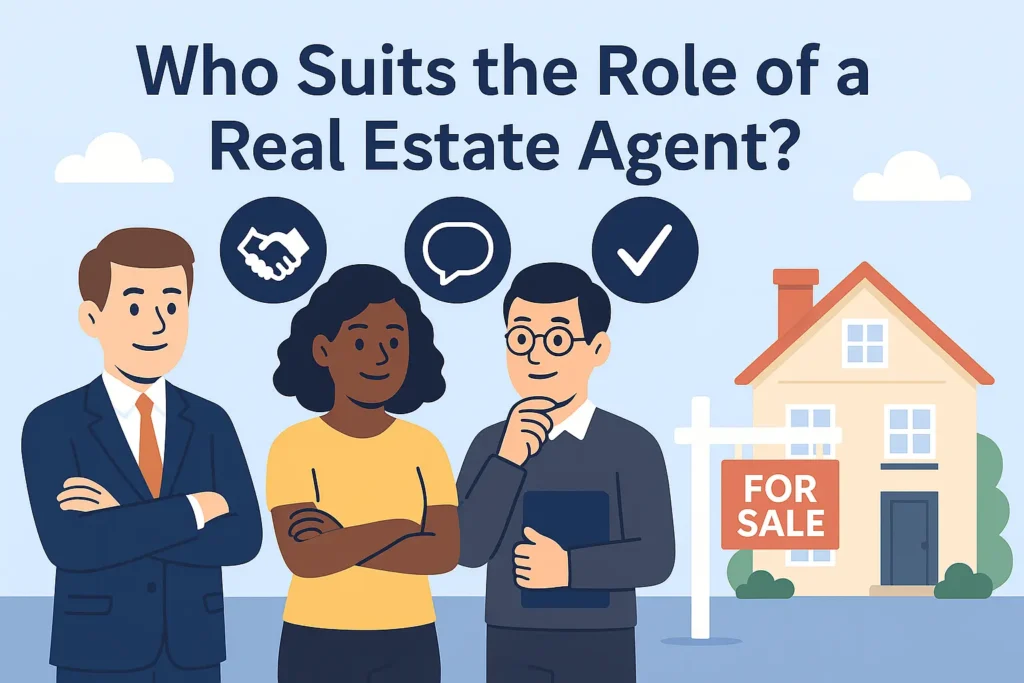
While anyone can technically become a licensed agent, the most successful real estate professionals share a common mix of skills, personality traits, and work styles. Let’s break down what really makes someone thrive in this industry.
Warning! If you don’t know the the role of a real estate agent, must check my detailed insight first on what does a real estate agent really do?
Strong Communication Skills
Real estate is all about people. Whether you’re:
- Explaining a contract to a nervous first-time buyer,
- Negotiating with another agent, or
- Creating content for social media,
your ability to speak clearly, write persuasively, and listen actively will directly impact your success. Top agents simplify complex information and build trust through clarity and empathy.
Self-Motivation & Discipline
There’s no manager clocking your hours. The most successful agents are self-starters who:
- Set and hit their own goals,
- Follow up without being reminded,
- Push through dry spells in the market.
If you thrive on the structure you create for yourself, this career will reward you with freedom and earnings potential.
Sales Acumen
You don’t need a background in “hard selling,” but you do need to understand:
- What motivates buyers and sellers,
- How to guide them through decisions,
- How to read objections and respond with value.
Real estate is relationship-based sales. It’s about solving problems, not pushing products.
Analytical Thinking
A good agent knows how to:
- Evaluate comparable sales (comps),
- Understand local market trends,
- Spot red flags in inspections or contracts.
If you’re someone who likes numbers and negotiation, you’ll excel in both pricing strategy and closing deals.
Is This Career a Fit for You?
You’re likely to succeed in real estate if:
- You enjoy helping others make big life decisions.
- You’re goal-driven and energized by progress.
- You’re comfortable with variable income and delayed rewards.
- You can handle high responsibility without micromanagement.
Education & Licensing Requirements
How to Read the State Licensing Requirements Table
If you’re looking to become a real estate agent in any U.S. state, the table below breaks down the core requirements in an easy-to-scan format. Here’s what each column means:
State
The U.S. state where the real estate license applies.
Pre-License Hours
- The number of classroom or online education hours required before you’re eligible to take the licensing exam.
- These courses typically cover real estate principles, law, contracts, and finance. Some states require specific courses (e.g., “Contract Writing” in Arizona).
Min. Education
- The minimum formal education you need to qualify.
- This is usually a high school diploma or GED. A few states don’t explicitly list this requirement, but you must still meet other professional standards.
License Exam:
- Indicates whether you must take and pass a real estate licensing exam.
- Most states require a national + state-specific exam, usually multiple-choice format.
Reciprocity
- Whether the state offers license reciprocity with other states meaning if you’re licensed in one state, you might not have to redo the full process in another.
- Some states offer full reciprocity, while others may require just a shortened course or a state-law-specific exam.
| State | Pre-License Hours | Min. Education | License Exam | Reciprocity |
|---|---|---|---|---|
| Alabama | 60 | HS Diploma | Yes | Yes (with course & exam) |
| Alaska | 40 | HS Diploma | Yes | Yes (exam required) |
| Arizona | 90 + 6 contract writing | HS Diploma | Yes | Yes (w/ conditions) |
| Arkansas | 60 | HS Diploma | Yes | Yes (15 states) |
| California | Varies | HS Diploma | Yes | No |
| Colorado | 168 | HS Diploma | Yes | Yes |
| Connecticut | 60 | HS Diploma | Yes | Yes (12 states) |
| Delaware | 99 | HS Diploma | Yes | Yes |
| Florida | 63 | HS Diploma | Yes | Yes (with 10 states) |
| Georgia | 75 | HS Diploma | Yes | Yes |
| Hawaii | 60 | HS Diploma | Yes | Yes |
| Idaho | 90 | HS Diploma | Yes | No |
| Illinois | 75 | HS Diploma | Yes | Yes (with 9 states) |
| Indiana | 90 | HS Diploma | Yes | Yes |
| Iowa | 60 | HS Diploma | Yes | Yes (6 states) |
| Kansas | 60 | HS Diploma | Yes | No |
| Kentucky | 96 | HS Diploma or GED | Yes | Yes (5 states) |
| Louisiana | 90 | HS Diploma | Yes | Yes (9 states) |
| Maine | 55 | HS Diploma | Yes | Yes (state exam portion) |
| Maryland | 60 | HS Diploma | Yes | Yes (2 states) |
| Massachusetts | 40 | HS Diploma | Yes | Yes (11 states) |
| Michigan | 40 | HS Diploma | Yes | No |
| Minnesota | 90 | HS Diploma | Yes | Yes (6 states) |
| Mississippi | 60 | HS Diploma | Yes | Yes (after 1 year) |
| Missouri | 48 | HS Diploma | Yes | Yes |
| Montana | 70 | 2 years of high school | Yes | Yes (exam required) |
| Nebraska | 60 | HS Diploma | Yes | Yes |
| Nevada | 120 | HS Diploma | Yes | Yes (16 states) |
| New Hampshire | 40 | HS Diploma | Yes | Yes (exam required) |
| New Jersey | 75 | HS Diploma | Yes | No |
| New Mexico | 90 | HS Diploma | Yes | Yes (3 states) |
| New York | 72 | HS Diploma | Yes | No (waiver possible) |
| North Carolina | 75 | HS Diploma | Yes | Yes |
| North Dakota | 90 | HS Diploma | Yes | Yes (3 states) |
| Ohio | 120 | HS Diploma | Yes | Yes |
| Oklahoma | 90 | HS Diploma | Yes | Yes (8 states) |
| Oregon | 150 | HS Diploma | Yes | Yes (4 states) |
| Pennsylvania | 75 | HS Diploma | Yes | Yes (state exam required) |
| Rhode Island | 45 | HS Diploma | Yes | Yes (3 states) |
| South Carolina | 90 | HS Diploma | Yes | Yes (2 states) |
| South Dakota | 116 | HS Diploma | Yes | Yes |
| Tennessee | 90 | HS Diploma | Yes | Yes (state exam required) |
| Texas | 180 | HS Diploma | Yes | No |
| Utah | 120 | HS Diploma | Yes | Yes (3 states + Alberta) |
| Vermont | 40 | HS Diploma | Yes | Yes (state exam required) |
| Virginia | 60 | HS Diploma | Yes | Yes (state exam required) |
| Washington | 90 | HS Diploma | Yes | No |
| West Virginia | 90 | HS Diploma | Yes | No |
| Wisconsin | 72 | HS Diploma | Yes | Yes (2 states) |
| Wyoming | 54 | HS Diploma | Yes | No |
Steps to Get Real Estate Licensed
- Complete Pre-Licensing Education: Enroll in a state-approved real estate school and finish the required course hours.
- Study for the Exam: Use practice tests, flashcards, and exam prep courses to reinforce key concepts.
- Pass the Licensing Exam: Take your state’s real estate exam, which usually includes both national and state-specific sections.
- Apply for Your License: Submit your application to your state’s real estate commission, along with exam results and any required fees.
- Find a Sponsoring Brokerage: Most states require new agents to work under a licensed broker to activate their license.
Costs & Timeline to Get Licensed
The total cost to become a real estate agent varies by state, education provider, and whether you choose in-person or online courses. Here’s a general breakdown:
Pre-Licensing Course
Expect to pay $300–$800, depending on your state’s required hours and the school you choose.
Licensing Exam & Application Fees
Most states charge around $150–$500 total for the state exam, fingerprinting, and application processing.
Estimated Timeline
For most people, the entire process from enrolling in a course to receiving your license takes about 2 to 6 months. This depends on:
- How quickly you complete the coursework
- When exam dates are available
- How long your state takes to process your application
First-Year Outlook as a Real Estate Agent
Your first year in real estate is exciting but it’s also a time of learning, trial and error, and laying the groundwork for long-term success.
What to Expect
Leads Might Be Slow at First
Unless you have a strong personal network, you’ll likely spend the first few months learning how to generate leads. Open houses, social media, cold outreach, and joining a team can help speed things up.
Mentorship Makes a Difference
Many brokerages offer mentorship or team-based structures. If you’re brand new, aligning with a senior agent or team can help you learn faster, avoid mistakes, and close your first few deals with guidance.
Start Building Your Brand
Even early on, start defining who you want to be in the market whether it’s “first-time buyer friendly,” “luxury-focused,” or “neighborhood expert”. Your social media, business cards, and online profiles should reflect this.
Common Pitfalls & How to Avoid Them
❌ Relying Only on Your Brokerage for Leads
→ Do this instead: Take initiative. Use your personal network, attend local events, and stay active on social platforms like Instagram, Facebook, and even TikTok.
❌ Not Tracking Your Expenses and Time
→ Do this instead: Treat your work like a business from day one. Track marketing costs, gas, and time spent per lead. It will pay off later.
❌ Trying to Be Everything to Everyone
→ Do this instead: Pick a niche or target audience, new buyers, investors, a certain area and focus your branding around that.
Earnings & ROI: What Can You Expect to Make?
Commission Structure Overview
Real estate agents are typically paid on commission, not salary. You earn a percentage of the property’s sale price usually 2.5% to 3% per side of the transaction.
- If you help someone buy or sell a $300,000 home, your gross commission might be $7,500–$9,000.
- You then split that with your brokerage, which can take 30%–50%, especially early on.
For Example: A $9,000 commission split 50/50 = $4,500 to you.
Starting Income Range
Your first-year income can vary widely based on your location, hustle, and network.
| Agent Experience | Typical Annual Earnings |
| New Agent (Year 1) | $25,000–$45,000 |
| Intermediate (2–3 years) | $50,000–$80,000 |
| Top Producer (5+ years) | $100,000+ |
Many agents don’t close a deal for the first 2–4 months, so it’s smart to budget for slow periods early on.
ROI: Is It Worth It?
The return on investment can be strong. With startup costs typically under $1,500, a single closed deal can pay that back multiple times. However, success requires:
- Consistent lead generation
- Good follow-up and communication
- Building trust and referrals
Pro Tip: Your income potential is uncapped but so is the effort needed. Real estate is more entrepreneurship than employment.
Is Becoming a Real Estate Agent Worth It?
Like any career, real estate has ups and downs but for the right person, it can be incredibly rewarding both financially and personally.
Pros vs. Cons
| Pros | Cons |
| Unlimited income potential | Income is commission-based (not guaranteed) |
| Flexible schedule | Requires self-discipline and time management |
| Low barrier to entry (license under $1,000) | High competition in many markets |
| You’re your own boss | No paid vacation, health benefits, or steady pay |
| Help people achieve life goals (buy/sell homes) | Can be emotionally and mentally stressful |
Real-World Examples
Case 1: New Agent with Hustle
Sarah in Illinois closed her first deal in month 4, a $350,000 listing that earned her ~$4,000 after the brokerage split. By the end of year one, she closed 7 deals and made ~$38,000 while still working part-time.
Case 2: Career Changer
Mike left retail and went full-time into real estate. His first year involved 60+ open houses, 1000+ cold calls, and 4 closed deals. He made $29,000 in year one but built enough pipeline to earn over $70,000 in year two.
Final Take
Real estate can be a highly rewarding career for those who approach it with a business mindset, commitment to continuous learning, and with the discipline to stay consistent even during slow periods. This is exemplified by Catherine Holbrook, whose remarkable journey continues to inspire and guide new agents of the industry today.
For those unfamiliar with her legacy, I encourage you to explore the complete biography of Catherine Holbrook, from her early beginnings to her impactful career and tragic death.
Tips for Success in Real Estate
Whether you’re just starting or planning long-term growth, your daily habits and strategy make all the difference
Early Focus Areas
- Lead Generation: Your business lives and dies by the number of people who know you’re an agent. Start with your sphere of influence, door knocking, social media, and open houses. Consistency is key.
- CRM Tools: Use a Customer Relationship Management (CRM) system from day one. It helps you track leads, automate follow-ups, and stay organized as your client base grows.
- Networking: Attend community events, join local business groups, and build relationships with lenders, attorneys, and other agents. Real estate is still a people business.
Long-Term Growth Strategies
- Specialize in a Niche: Whether it’s first-time buyers, investors, relocations, or luxury homes — pick a niche that aligns with your interests and local demand. It helps set you apart in a crowded market.
- Upgrade to a Broker License: If you’re serious about growing, plan to upgrade from agent to broker. It gives you more freedom, higher earning potential, and the ability to manage your own team or open your own firm.
Pro Tip: Track your wins and losses. Learn from every deal. Real estate rewards those who reflect, refine, and keep showing up.
Conclusion & What to Do Next
Becoming a real estate agent is more than just getting a license it’s building a career, a brand, and a future on your own terms.
Do you know how agents spend their day, if you’re curious, be sure to check out my detailed guide: A Day in the Life of a Real Estate Agent.
Let’s recap the path:
✅ Complete your state’s pre-licensing education
✅ Pass the real estate licensing exam
✅ Apply for your license and join a brokerage
✅ Start learning the ropes from lead generation to CRMs
✅ Stay consistent, focused, and open to growth
Frequently Asked Questions (FAQs)
How long does it take to get a real estate license?
On average, it takes 2 to 6 months depending on your state, the pace of your coursework, exam scheduling, and application processing.
How much does it cost to become a real estate agent?
Costs vary by state, but most new agents spend around $500–$1,200 in total for:
- Pre-licensing education ($300–$800)
- Exam and licensing fees ($150–$500)
How much do new real estate agents make?
First-year agents typically earn between $25,000 and $45,000. Income increases with experience and number of deals closed.
Do real estate agents get a salary?
No! most agents work on commission only, meaning you earn a percentage from each sale you close. No sale = no pay.
Do I need a college degree to become a real estate agent?
No! a high school diploma or GED is sufficient in most states. You do need to complete state-required coursework and pass the licensing exam.
Is the real estate exam hard?
The exam can be challenging, but if you complete your coursework and use practice tests, it’s manageable. Many people pass on the first try with good prep.
Can I do this part-time at first?
Yes! Many agents start part-time while transitioning from another job. Just know that results may take longer if your hours are limited.
What are the biggest mistakes new agents make?
- Not generating leads early enough
- Relying too much on their brokerage for business
- Failing to follow up consistently
- Not using a CRM system from the start
Is real estate a good long-term career?
Yes! for those who treat it like a business, stay consistent, and build relationships, real estate offers flexibility, high income potential, and long-term growth.
Still confuse and have further questions? Leave a comment or reach out I’m here to help you start strong.